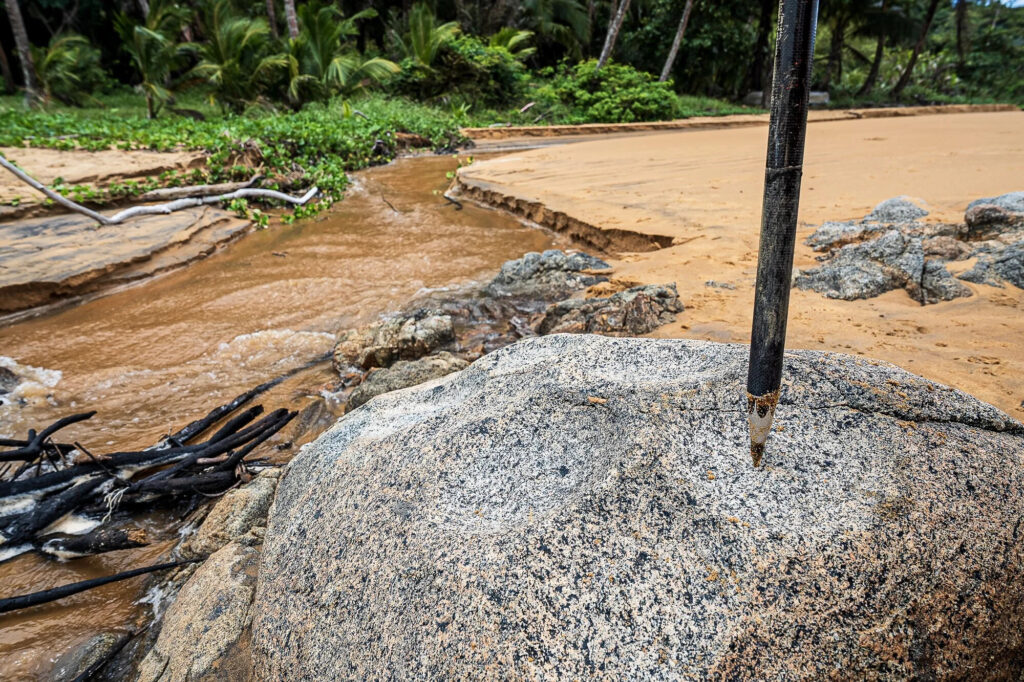
In French Guiana, the coastline is in perpetual motion. Under the effect of currents from the Amazon, tropical rains and coastal erosion, the shoreline is constantly changing.
These incessant movements of sand and water uncover and then hide again rocks bearing traces left by Amerindian populations of the pre-Columbian era, between 5000 BC and AD 1500, who came to shape their stone tools. Still undocumented, some of these remains are thus visible for only a few days or a few months before being covered by sand again.
For scientists, it is a race against the erasure of an Amerindian heritage that is still largely unknown. Archaeologist Lolita Rousseau coordinates a research program devoted to pre-Columbian lithic objects in French Guiana, involving university researchers, the CNRS and INRAP. With archaeologist-surveyor Pascal Combes, they are trying to digitally preserve these “archaeological windows” before they disappear, using technologies such as photogrammetry, topographic surveys and 3D modeling.
Story available to the press, on commission or through the photo library.Request a license
The story
20 images