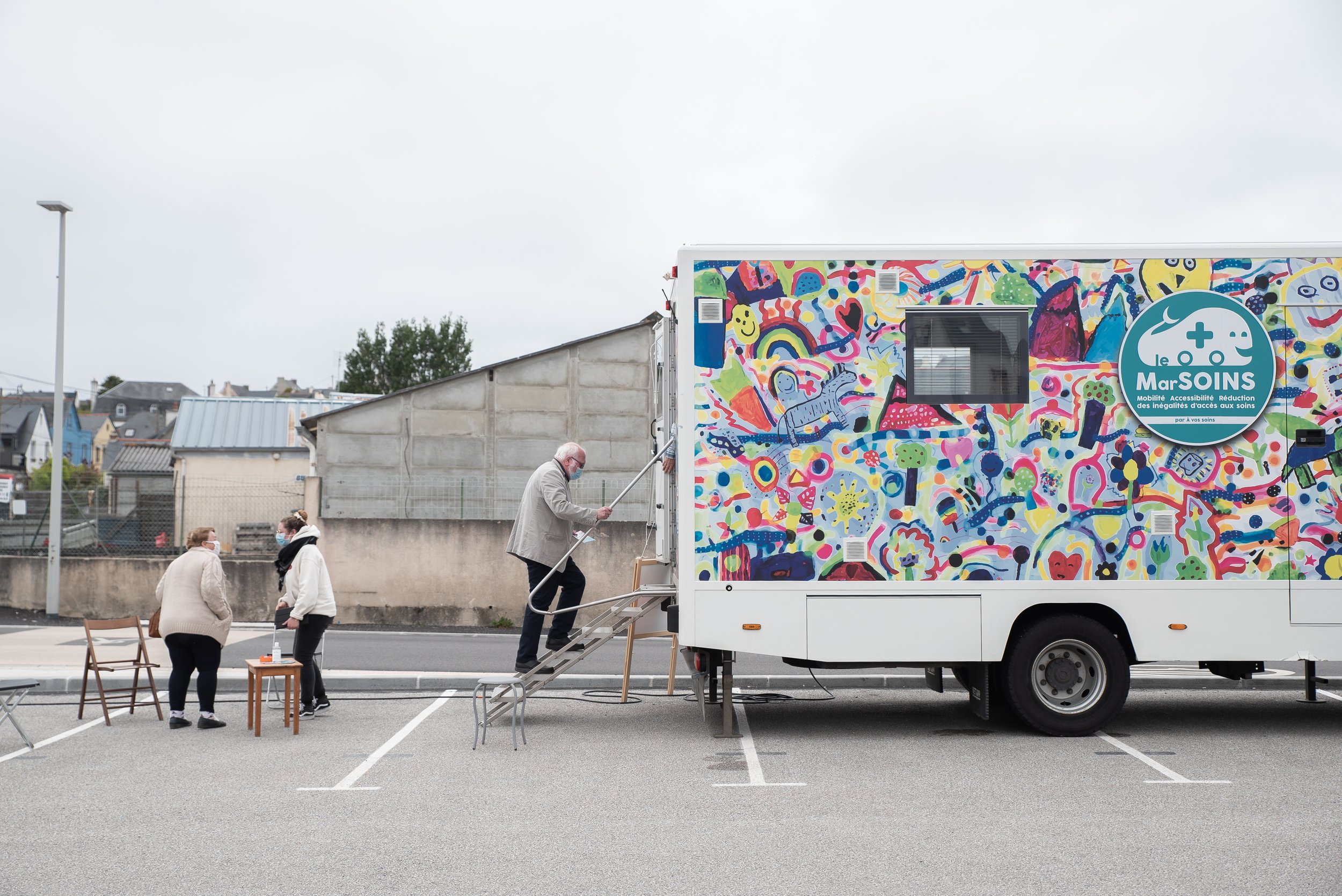
Medical deserts are spreading in France, particularly in rural or remote areas. In Camaret-sur-Mer in Brittany, at this French land’s end, the aging population faces a shortage of general practitioners and specialists. Waiting times and distances to get an appointment are growing: 4 months and 45 km for an ophthalmologist, 6 months and 60 km for a dentist. To reduce inequalities in access to care, an association, in partnership with the health authorities, has for five years been offering a network of mobile health units. In Loire-Atlantique, they travel around working-class neighborhoods, while in Finistère they crisscross the medical deserts, including that of the Crozon peninsula. This outpost on wheels, without replacing genuine medical provision for now, nonetheless gives these populations access to prevention, screenings and first-line diagnoses. The program’s status does not allow it to issue prescriptions, only to help with the care pathway and refer people to the right professionals if needed. A band-aid on a wooden leg, but one that still receives very favorable feedback locally. Volunteer health professionals give their time here to patients who come without an appointment. Mireille [name changed] has come today for an eye screening. She says she is “satisfied that this initiative exists, because the nearest ophthalmologist is in Chateaulin or Brest, more than an hour’s drive away”. Jean-Yves Le Manac’h is a former general practitioner. His second hat as a heavy-truck driver makes him a key part of the program, to which he gives two days a week. “I am happy and proud to be part of it, it gives my retirement meaning,” he says. Nicolas Blouin is co-founder of the association A vos Soins, which came up with this solution. The team has now managed to bring a large number of healthcare players together around this project, but that has not always been the case. “Originally, we did not come from the medical field. This sidestep has sometimes worked against us, but it also allows us to think outside the box, to have an external and objective eye on healthcare provision. People often objected that we were creating a need in areas where no treatment could be provided. But the need is already there, there is no point closing our eyes to it!” he recounts. “Sometimes we only have two patients in an afternoon, but those are two people who got a quick diagnosis of a serious condition, which then allowed them to receive appropriate care.”
The project benefits from impact indicators, through the monitoring of a panel of volunteer patients. “This gives the ARS (Regional Health Agency, editor’s note) a fine-grained sensor on the ground, while allowing us to improve our actions.” In total, several hundred people benefit from it each year, half of whom then enter a care pathway. Building on this success, a third vehicle is being fitted out for other areas.
Story available to the press, on commission or through the photo library.Request a license
The story
9 images


